How to Prepare Audio for Afterparties — Lounge & Small Venue Guide
Learn how to optimize your DJ tracks for afterparty venues. Understand small room acoustics, ideal LUFS settings for lounges, and how to use DeckReady's Lounge preset for intimate spaces.
Afterparties Have a Completely Different Sound Environment#
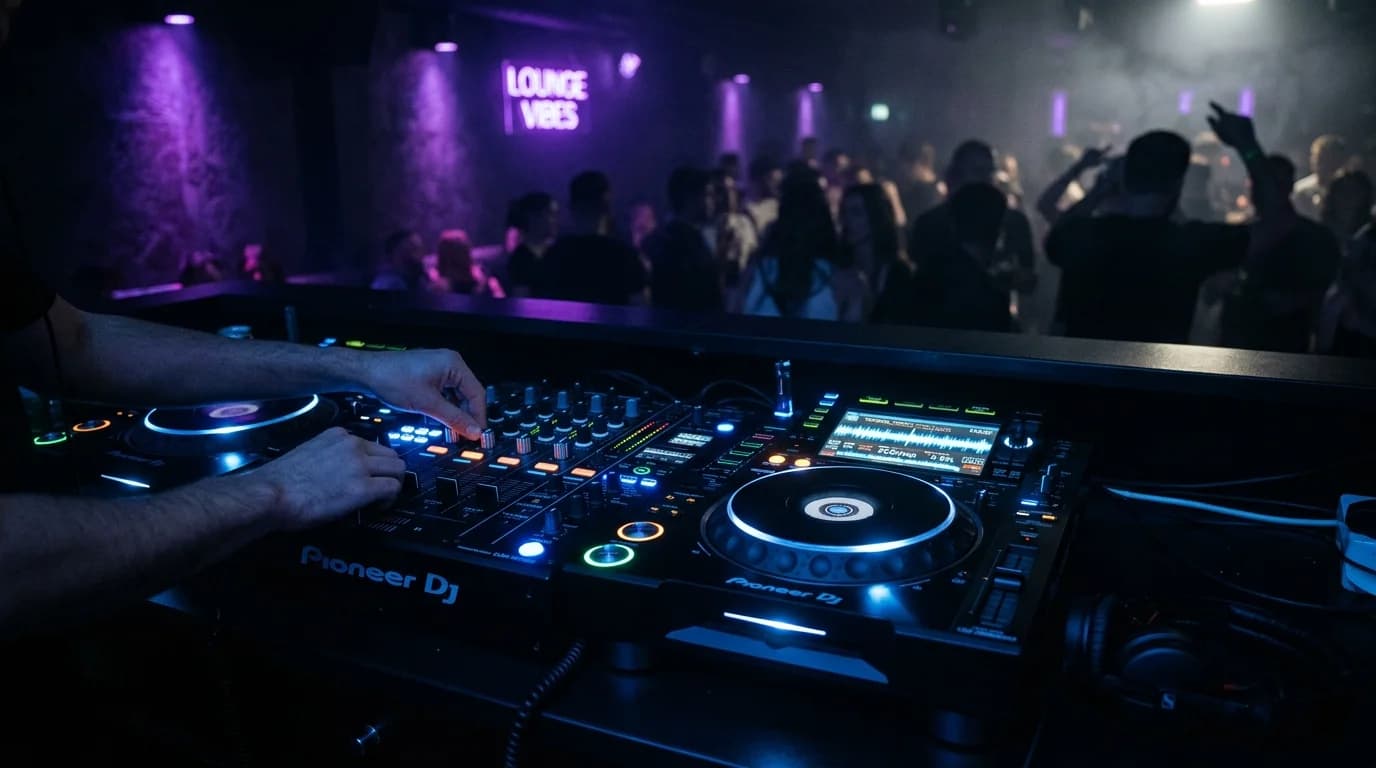
When the main event ends, the afterparty moves to a smaller, more intimate space — a bar, rooftop terrace, lounge, or private room. The sound environment is fundamentally different from the main floor.
The common thread is lower volume and a more intimate setting. If you play tracks mastered for a club's main room, the sound will be too aggressive, the bass too heavy, and the vibe will be wrong for the afterparty atmosphere.
Small Room Acoustics#
The Low-End Problem#
In small spaces, wall reflections over-amplify bass frequencies. This is called "room modes" — specific frequencies resonate with the room dimensions. In a typical bar or lounge (roughly 200–600 sq ft), resonance peaks tend to appear in the 60–120 Hz range, right where kick drums and basslines live. The result is a muddy, boomy low end.
Near-Field Listening#
On a club's main floor, listeners are 10–40 feet from the speakers. In a lounge, they're 3–10 feet away. Near-field listening means:
- Direct sound dominates, creating a sharper image
- High frequencies are more prominent
- Listening fatigue sets in faster at high levels
- Stereo image feels wider
Coexisting with Conversation#
At an afterparty, music often serves as background. People are talking, socializing, winding down. The music needs to complement conversation, not compete with it.
- Vocal frequencies (1–4 kHz) should not overpower speech
- Excessive bass masks the low end of human voices
- Target around 60–75 dB SPL (normal conversation remains comfortable)
Why Main-Room Masters Don't Work#
Tracks mastered for the main floor (typically -6 to -8 LUFS) cause three problems at afterparties:
1. No dynamics — Heavy limiting flattens the dynamic range. At lower volumes, this sounds boring and lifeless.
2. Excessive bass — Sub-heavy masters designed for club subwoofers sound unnatural and muddy on smaller speaker systems.
3. Listening fatigue — Over-limited audio fatigues the ears even at low volumes.
Preparing Afterparty Audio#
Loudness Settings#
| Environment | Recommended LUFS | Characteristics |
|---|---|---|
| Main floor | -6 to -8 LUFS | Maximum impact, sub-optimized |
| Lounge / bar | -10 to -12 LUFS | Balanced dynamics, conversation-friendly |
| Rooftop | -9 to -11 LUFS | Accounts for ambient noise |
| Private room | -11 to -14 LUFS | Widest dynamic range |
DeckReady's Lounge Preset#
DeckReady includes a Lounge preset optimized specifically for intimate venues:
- Lower LUFS target than club presets
- Preserves wide dynamic range
- Controls excessive low-end energy
- Maintains mid-high clarity with a smooth, ear-friendly finish
Workflow:
- Upload your afterparty tracks in batch
Select the "Lounge" preset 3. Run batch processing 4. Download and load onto your USB
Managing Two Sets#
If you play the same tracks at both the main event and afterparty, you'll need two versions:
/DJ_Library/
  ├── Club_Ready/        ← Processed with Club preset
  │   └── House/
  │       └── Track_A.wav
  └── Lounge_Ready/      ← Processed with Lounge preset
      └── House/
          └── Track_A.wav
Keep separate playlists or crates in your DJ software to avoid confusion during the gig.
Genre Selection for Afterparties#
Deep House#
The classic afterparty genre. Deep basslines and ambient pads suit the late-night mood perfectly.
- BPM: 118–124
- Keep bass controlled while preserving groove
- Emphasize spatial elements like pads and atmospherics
Nu-Disco / Cosmic#
Funky and mellow sounds fit lounge environments beautifully.
- BPM: 115–122
- Guitar and synth melodies at conversation-friendly volumes
- Maintain groove without aggressive elements
Afro House / Organic House#
Organic percussion rhythms and ethnic melodies create a warm atmosphere.
- BPM: 120–126
- Ensure enough dynamic range to hear percussive detail
- Warm but controlled low end
Lo-Fi / Chillout#
The most relaxed option for late-night wind-down.
- BPM: 70–100
- Maximum dynamic range (-12 to -14 LUFS)
- Warm, analog-inspired texture
On-Site Setup Tips#
Speaker Check#
When you arrive at the afterparty venue:
- Note speaker placement relative to seating
- Check for a subwoofer (don't over-boost bass if there isn't one)
- Measure the distance from speakers to the nearest listeners
Volume Strategy#
- Start at a low volume where people can easily talk from 6 feet away
- Gradually increase as the party warms up
- After 3 AM, bring it back down (neighbor consideration + ear fatigue)
EQ Adjustments#
- Low (Bass): Cut in small rooms to tame room modes
- Mid: Adjust so vocals in tracks don't clash with conversation
- High (Treble): Slightly reduce for near-field listening to prevent ear fatigue
FAQ#
Can I use the same USB for both main set and afterparty?#
Yes. Create separate playlists ("Club_Set" and "After_Set") in rekordbox. Just make sure file names distinguish between Club-preset and Lounge-preset versions of the same track.
Can I just turn down the volume on Club-preset tracks?#
Lowering volume alone isn't enough. Club-preset tracks have narrow dynamic range from heavy limiting. At low volumes, this translates to flat, lifeless sound. The Lounge preset preserves dynamics, so music stays expressive even at quiet levels.
Does afterparty DJing require less skill?#
Actually, it demands different and arguably more refined skills. BGM-style DJing requires the music to blend naturally into the space. Track selection, volume micro-adjustments, and EQ finesse all matter more. Having uniformly mastered audio frees you to focus on these subtle controls.
Summary#
Afterparty audio preparation requires a fundamentally different approach from main-event mastering. Understanding small-room acoustics, using appropriate loudness targets, and preserving dynamic range are the keys to creating the right atmosphere.
DeckReady's Lounge preset streamlines afterparty preparation. Managing two sets (main and after) takes extra effort, but delivering audio optimized for each environment will noticeably elevate your reputation as a DJ.
Get DJ mastering tips
Weekly tips for music production.