Outdoor Festival Mastering: How to Prepare Your Tracks for Open-Air Sound
Learn how outdoor acoustics differ from indoor venues, why low-end disappears outside, and how to master your DJ tracks for festivals with the right LUFS targets and low-frequency treatment.
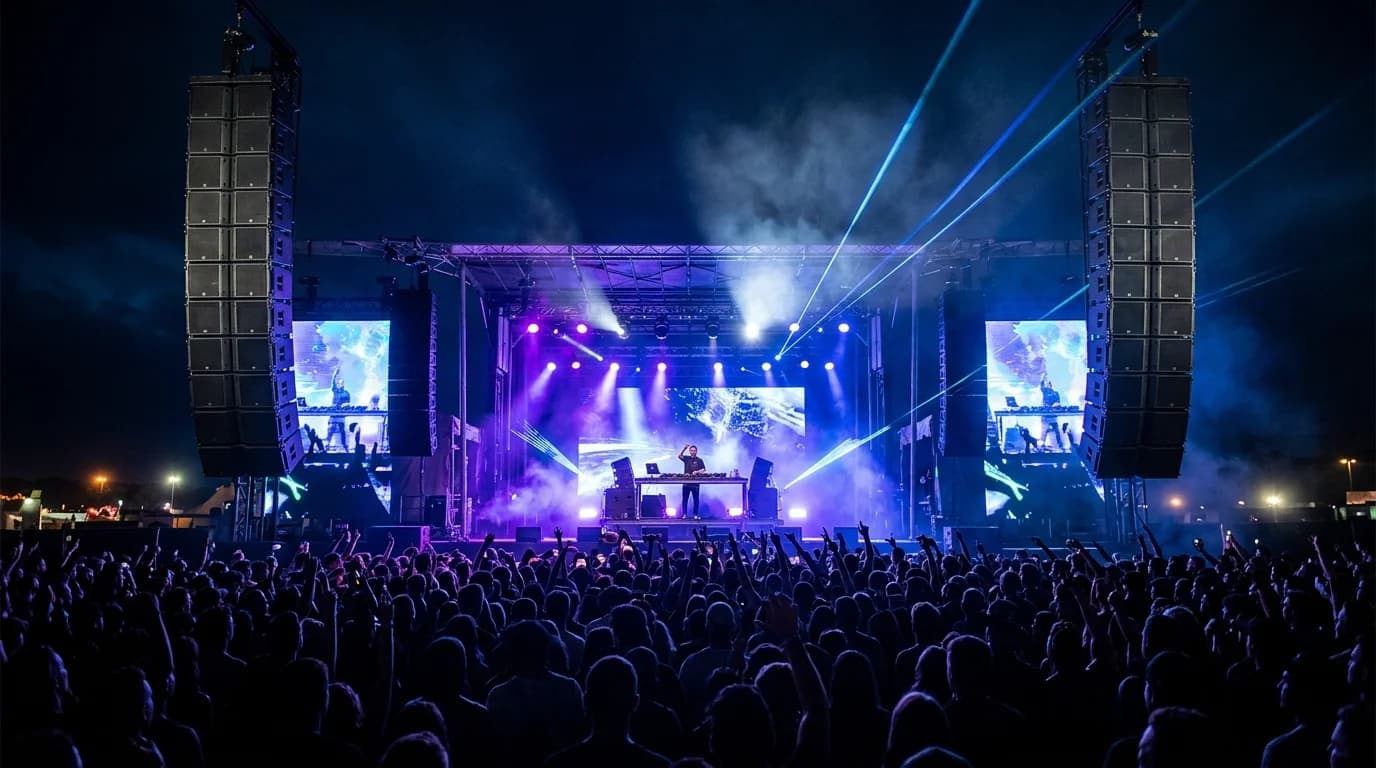
Outdoor Sound Is Nothing Like Indoor Sound#
A track that sounds perfect in a club can fall flat on a festival stage. This is well-known among DJs and PA engineers.
Without walls and ceilings to reflect sound, outdoor environments cause acoustic energy to dissipate far more rapidly. Low frequencies are particularly affected — the thick, powerful bass you feel indoors can sound thin and underwhelming outside.
This guide covers the science behind outdoor acoustics and practical mastering strategies for festival performance.
Three Factors That Change Sound Outdoors#
1. Low-Frequency Loss#
Indoor environments naturally boost low frequencies through reflections from walls, ceiling, and floor — an effect called "room gain." Small rooms exaggerate this effect significantly.
Outdoors, room gain doesn't exist. The same track played outside will sound noticeably thinner in the lows. Expect a perceived 3–6dB reduction below 100Hz.
2. Wind and Temperature#
Wind literally "blows sound away." Specific effects include:
- Headwind: Pushes sound back toward the stage, weakening reach to rear audience areas
- Tailwind: Carries sound further but can create excessive near-field levels
- Temperature gradients: Temperature differences between ground level and higher altitudes cause sound waves to refract, changing how far they travel
Temperature also matters: hot days reduce air density, increasing the speed of sound. Cold days increase density, typically producing clearer sound transmission.
3. Open-Space Dissipation#
In clubs, the farthest listener might be 10–20 meters from the speakers. At outdoor festivals, you may need to reach audiences 50–100+ meters away. When distance doubles, sound pressure drops by approximately 6dB (inverse square law).
Outdoor Mastering Principles#
LUFS Targets#
Club mastering typically targets -6 to -8 LUFS, but for outdoor events, aim slightly higher at -5 to -7 LUFS.
This isn't about recklessly pushing loudness — it's about maintaining adequate headroom while ensuring sufficient energy to compensate for outdoor losses.
Low-End Reinforcement#
To compensate for the absence of room gain, a subtle boost (+1–2dB in the 60–100Hz range) is effective. However, excessive boosting increases speaker load, so restraint is key.
Dynamic Range Management#
Outdoor environments have constant ambient noise — wind, crowd noise, sound bleed from adjacent stages. This means quiet passages in tracks can get lost in the environmental noise floor.
Moderate compression helps maintain sufficient loudness in the quietest sections to stay above ambient noise levels.
DeckReady Settings for Outdoor Use#
Using the Club Preset#
DeckReady's Club preset uses LUFS targets designed for club environments, but it works well for outdoor festivals too.
Why the Club preset works outdoors:
- Sets a LUFS target that ensures sufficient loudness
- Limiting controls peaks appropriately
- Low-end processing is optimized for large speaker systems
Additional checks after processing:
- Waveform inspection: Confirm peaks stay within -0.3dBFS
- Low-end monitoring: Check bass weight on headphones (monitor speakers alone can't predict outdoor bass behavior) 3. A/B comparison: Compare processed and unprocessed versions on headphones for natural sound quality
Batch Processing Benefits#
Festival sets typically run 30–90 minutes. Batch-processing your entire setlist eliminates inter-track loudness variations, enabling smooth mixing even in high-volume festival environments.
Genre-Specific Outdoor Adjustments#
Techno and Hard Techno#
Among the most common genres on outdoor main stages. Kick and bass energy are the core of every track.
- Preserve kick attack clarity (2–5kHz) while ensuring low-end power (50–80Hz)
- Hi-hats and rides (8–16kHz) attenuate faster outdoors, so ensure they have adequate presence
House and Disco#
Groove and vocal clarity must coexist.
- Keep vocals above ambient noise by ensuring midrange clarity (1–4kHz)
- Maintain bassline warmth without allowing low-end bloat
Drum & Bass and Breakbeat#
Clean, fast beat patterns are essential.
- Sub-bass control (30–60Hz) is critical to prevent excessive low-end from large subwoofer arrays
- Preserve snare and break transients — keep compression conservative
Time-of-Day Considerations#
Outdoor festivals span different conditions depending on your set time.
Daytime#
Higher temperatures reduce air density, changing sound propagation. Listeners also tend to have slightly reduced hearing sensitivity in bright sunlight.
- Slightly brighter mid-highs (2–8kHz) help details carry in open-air environments
- Low-end can feel "lighter" during the day, so slightly heavier bass treatment is effective
- Tighter dynamic range is safer due to higher ambient noise
Sunset#
Temperature drops rapidly around sunset, creating large ground-to-altitude temperature differences. Sound refraction patterns change, potentially altering how far sound travels.
- No special mastering changes needed, but communication with PA staff is important
- As temperatures drop, low-end naturally becomes clearer and more defined
Nighttime#
Cooler air is denser, so sound carries further and more clearly than during the day. However, noise regulations may impose volume limits.
- Low-end processing can be slightly conservative since bass resonates better at night
- This is when listeners' hearing is most acute, so mastering quality is most audible
Day-of Checklist#
During Soundcheck#
- Play your tracks through the PA and verify low-end balance
- Check sound clarity 20–30 meters from the stage
- Confirm master limiter settings with PA staff
Before Your Set#
- Verify all tracks on USB/laptop have been DeckReady-processed
- Confirm mixer gain knobs are at 12 o'clock (for normalized tracks)
- Set headphone monitor to a comfortable level
During Your Set#
- If wind direction changes, alert PA staff for volume adjustments
- If adjacent stage bleed is noticeable, a slight low-end cut can reduce interference
- Watch for temperature shifts around sunset that change sound behavior
Festival Scale Considerations#
Large Festivals (thousands to tens of thousands)#
Dedicated PA teams manage each stage. Final loudness control is in the PA engineer's hands. Your job is to deliver consistently normalized tracks. DeckReady-processed audio ensures the PA engineer has a stable, predictable input signal.
Mid-Size Festivals (hundreds to a thousand)#
PA setups may be less robust. Weaker master limiters mean loud tracks can cause clipping. Pre-normalized tracks create uniform speaker load and stable playback.
Small Outdoor Parties (tens to a hundred)#
Portable PA systems have lower performance ceilings. Don't push loudness too hard — process with DeckReady's Club preset, then adjust gain down at the venue as needed.
Frequently Asked Questions#
Q: Does rain affect how sound carries?#
Yes. Moisture in the air absorbs sound energy, particularly in the high frequencies. However, this doesn't require mastering-level compensation — it's the PA engineer's domain to handle with live EQ.
Q: Do I need separate outdoor versions of my tracks?#
No. DeckReady's Club preset produces tracks that work in both clubs and outdoor settings. If you play the same tracks in both environments, creating separate outdoor versions is unnecessary. The preset is optimized for large sound systems in general.
Final Thoughts#
Outdoor mastering requires understanding acoustic behavior that differs fundamentally from indoor venues. Low-frequency loss, wind effects, and open-space dissipation all demand appropriate LUFS targets and low-end treatment.
DeckReady's Club preset provides settings that work effectively for outdoor environments, and batch-processing your entire setlist ensures consistent quality throughout your festival performance. If you have an outdoor gig coming up, make track preparation a priority.
Get DJ mastering tips
Weekly tips for music production.
Related Articles
EDM vs Techno Mastering: Genre-Specific Settings for DJs
Master EDM and techno tracks the right way. Learn genre-specific loudness targets, kick and bass processing, sidechain preservation, and how DeckReady's Club preset handles cross-genre DJ sets.
Serato DJ Audio Preparation Guide: Get Better Sound Quality
Learn how to prepare audio files for Serato DJ with the right formats, bitrates, and loudness normalization. Includes a DeckReady workflow for consistent sound pressure across your entire set.
How to Fix SoundCloud Audio Quality for Club-Ready DJ Sets
SoundCloud's 128kbps downloads sound weak on club systems. Learn how to optimize low-bitrate audio for professional DJ use with DeckReady's batch processing workflow.
How to Use Vinyl Rips in Digital DJ Sets
Complete guide to digitizing vinyl records for DJ use. Covers recording equipment, ripping workflow, noise reduction, loudness normalization with DeckReady, and format selection for rekordbox and Serato.