The Loudness War: A History of the Volume Arms Race in Music
Explore the history of the Loudness War from vinyl records to streaming normalization. Learn how the -14 LUFS standard ended decades of destructive compression, and why DJs still face loudness inconsistency today.
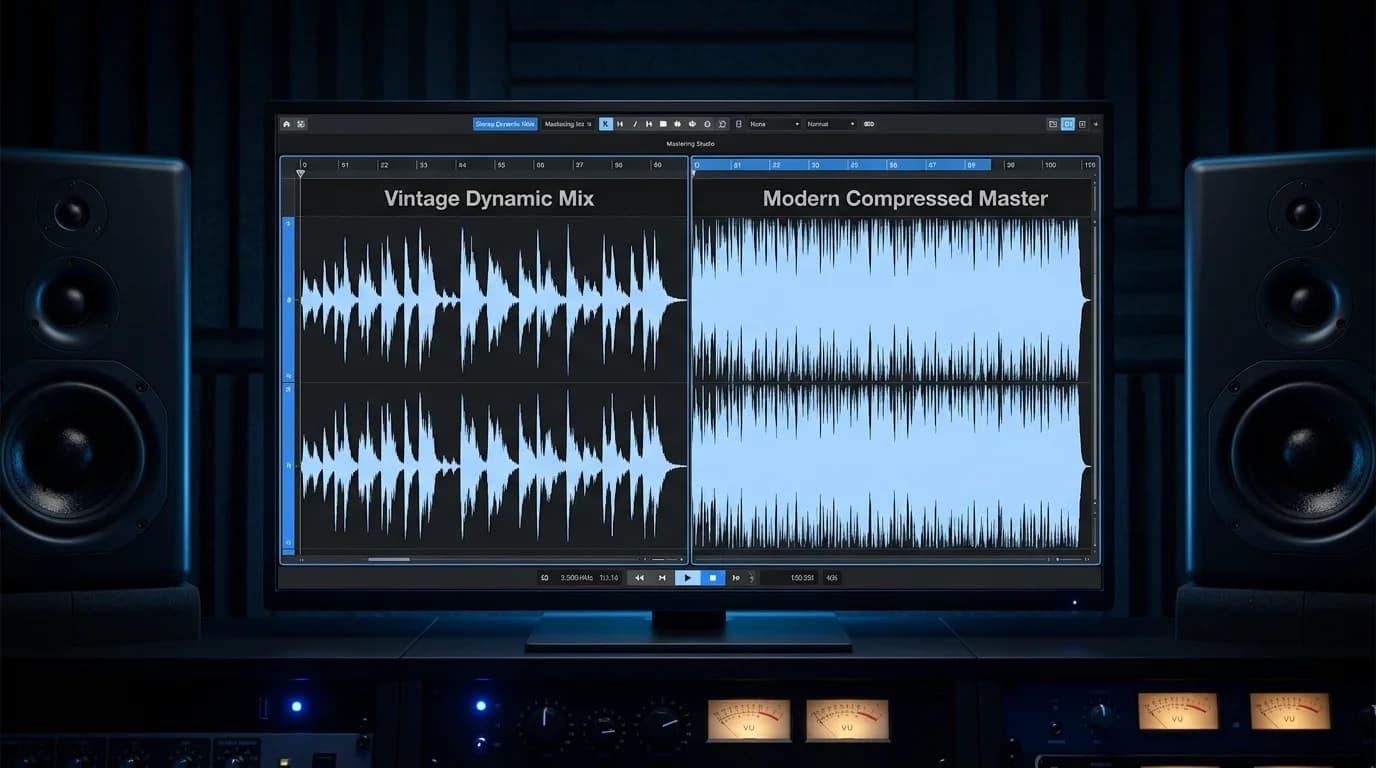
The "Louder Sounds Better" Trap#
Human hearing has a built-in bias: when comparing the same song at different volumes, the louder version sounds "better." This is explained by the Fletcher-Munson curves -- at higher volumes, our perception of low and high frequencies improves, making the sound feel richer and more full.
The music industry exploited this psychoacoustic quirk to launch the "Loudness War" -- a decades-long arms race to make records as loud as physically possible.
How the Loudness War Began#
The Vinyl Era (Pre-1980s)#
Analog records had built-in physical limits that acted as natural loudness constraints:
- Groove width: Too much bass would cause grooves to collide
- Needle skip risk: Extreme dynamics could bounce the stylus off the record
- Runtime tradeoff: Louder cuts required wider grooves, reducing total play time
These physical limitations kept loudness within a natural range for decades.
The CD Revolution (1982+)#
CDs eliminated every physical constraint. Digital audio has an absolute ceiling at 0 dBFS, but everything below that is fair game. Early CDs preserved the dynamic range of their vinyl predecessors, but by the 1990s, the landscape began to shift.
The 1990s: War Begins#
Around 1994, with releases like Oasis's "Definitely Maybe," rock and pop records started getting noticeably louder. The driving force was radio competition -- FM stations apply their own compression before broadcast, and louder masters cut through more effectively. Labels began demanding that mastering engineers push levels higher to gain an edge on the airwaves.
The 2000s: Total Escalation#
The loudness war reached its peak in the 2000s:
- Metallica "Death Magnetic" (2008): Clipping so severe that fans launched a petition demanding a remaster. The Guitar Hero version of the album actually sounded better.
- Red Hot Chili Peppers "Californication" (1999): Dynamic range crushed to the point where waveforms looked like solid black rectangles.
- Oasis: Each successive album was mastered louder than the last.
The Numbers Tell the Story#
| Year | Representative Album | Estimated Loudness |
|---|---|---|
| 1985 | Dire Straits - Brothers in Arms | -18 LUFS |
| 1991 | Nirvana - Nevermind | -14 LUFS |
| 1999 | RHCP - Californication | -8 LUFS |
| 2008 | Metallica - Death Magnetic | -5 LUFS |
In just 20 years, loudness increased by over 13 dB -- perceptually equivalent to sounding more than 20 times louder.
What Was Lost#
Dynamic Range Destruction#
Extreme limiting and compression produce devastating side effects:
- Peak clipping: The loudest moments (kick transients, vocal peaks) get shaved flat
- Quiet section elimination: Soft passages are pushed up, destroying contrast
- Waveform "bricking": The waveform becomes a solid rectangle, outputting near-maximum level at all times
Listening Fatigue#
Music without dynamic variation exhausts the ears. Human hearing relies on volume changes for "rest periods." Constantly maxed-out audio provides no relief, leading to rapid listener fatigue.
Artistic Limitation#
Just as classical music uses the range from pianissimo to fortissimo for emotional expression, pop and rock depend on dynamics too. A chorus hits harder when the verse is quieter. The Loudness War stripped away this expressive range.
Streaming Changed Everything#
Loudness Normalization Arrives#
Starting around 2014, major streaming platforms introduced loudness normalization:
- Measure each track's Integrated LUFS
Compare against the platform target (e.g., Spotify uses -14 LUFS) 3. Turn down tracks that exceed the target 4. Turn up tracks that fall below it
The War Becomes Pointless#
Normalization made the Loudness War self-defeating. A track crushed to -5 LUFS and one mastered at -14 LUFS now play at the same perceived volume. The difference? The -5 LUFS track gets turned down 9 dB and still has no dynamic range. Louder mastering now means worse results on streaming platforms.
Platform Standards#
| Platform | Target | Year Introduced |
|---|---|---|
| Spotify | -14 LUFS | 2014 |
| Apple Music | -16 LUFS | 2016 |
| YouTube | -14 LUFS | 2014 |
| Tidal | -14 LUFS | 2015 |
| Amazon Music | -14 LUFS | 2017 |
The Impact on DJs#
Streaming normalization doesn't apply to local files. When DJs play from purchased downloads, the original mastering loudness is preserved in full.
Persistent DJ Challenges#
- Era-based loudness gaps: 1990s tracks vs. 2020s tracks have completely different levels
- Label inconsistency: Major label releases vs. independent releases vary widely 3. Remaster confusion: Original and remastered versions of the same track at different levels 4. Genre differences: Techno/EDM masters are significantly louder than jazz or ambient
How DeckReady Solves This#
DeckReady normalizes all these loudness differences in a single batch operation. A deep house track from 1995 and a tech house banger from 2025 both come out at the same calibrated level through the Club Ready preset. Beyond simple volume matching, DeckReady also addresses the frequency balance differences between eras and genres, optimizing everything for modern club sound systems.
Current Mastering Trends#
Dynamic Range Renaissance#
The industry now widely recognizes that excessive loudness is counterproductive for streaming:
- -10 to -14 LUFS is the recommended range for streaming releases
- Genre-appropriate targets are preferred: EDM at -6 to -8 LUFS, jazz at -14 to -18 LUFS
- Intentional dynamics are being preserved again
Multi-Format Mastering#
Creating multiple masters for different use cases is increasingly common:
- Streaming version: -14 LUFS with wide dynamic range
- Club version: -7 LUFS with enhanced low end
- Radio version: -10 LUFS with midrange emphasis
Lessons Learned#
The Loudness War teaches clear lessons:
- Louder does not equal better -- dynamic range is part of musical expression
- Context determines the right level -- not everything should be maximally loud 3. Technology changes the rules -- normalization ended the war 4. DJs must optimize for their environment -- streaming standards and club standards differ
DeckReady applies these lessons automatically, delivering the scientifically appropriate loudness for each use case. Not over-compressed, not under-powered -- optimized for maximum impact in the target playback environment.
Summary#
The Loudness War was a volume arms race fueled by human psychoacoustics. It escalated from the 1990s through the 2000s, sacrificing the audio quality of countless classic albums. Streaming-era loudness normalization effectively ended the war, but DJs still face loudness inconsistency in their local libraries. Understanding this history is essential to grasping why loudness normalization matters -- and why tools like DeckReady target specific LUFS values for specific use cases.
Get DJ mastering tips
Weekly tips for music production.
Related Articles
Mastering for Music Producers: A Practical Beginner's Guide
Learn mastering fundamentals for producers and beatmakers. Understand LUFS targets for every platform, when to self-master vs. hire a pro, and how DeckReady's custom LUFS feature streamlines your workflow.
Streaming Platform Loudness Standards: Complete 2026 Guide
Compare LUFS targets for Spotify, Apple Music, YouTube Music, Amazon Music, and Tidal. Learn the optimal mastering settings to avoid loudness penalties and ensure your music sounds great everywhere.
What Is LUFS? The Loudness Standard Every DJ Needs to Understand
LUFS explained for DJs: how it differs from dB and RMS, why it matters for streaming and club playback, recommended values by genre, and how DeckReady uses LUFS-based processing for consistent sets.
How to A/B Compare Audio Like a Pro — Train Your Ears
Learn the correct way to A/B compare audio before and after processing. Eliminate loudness bias, use blind testing, and focus on the right frequency bands to make better mixing and mastering decisions.