Sub Bass Essentials: Low-End Processing for Club Sound Systems
Understand the 20-80Hz sub bass range and how to process it for club playback. Covers subwoofer systems, mono summing, kick-bass separation, and DeckReady's sub bass presets for different genres.
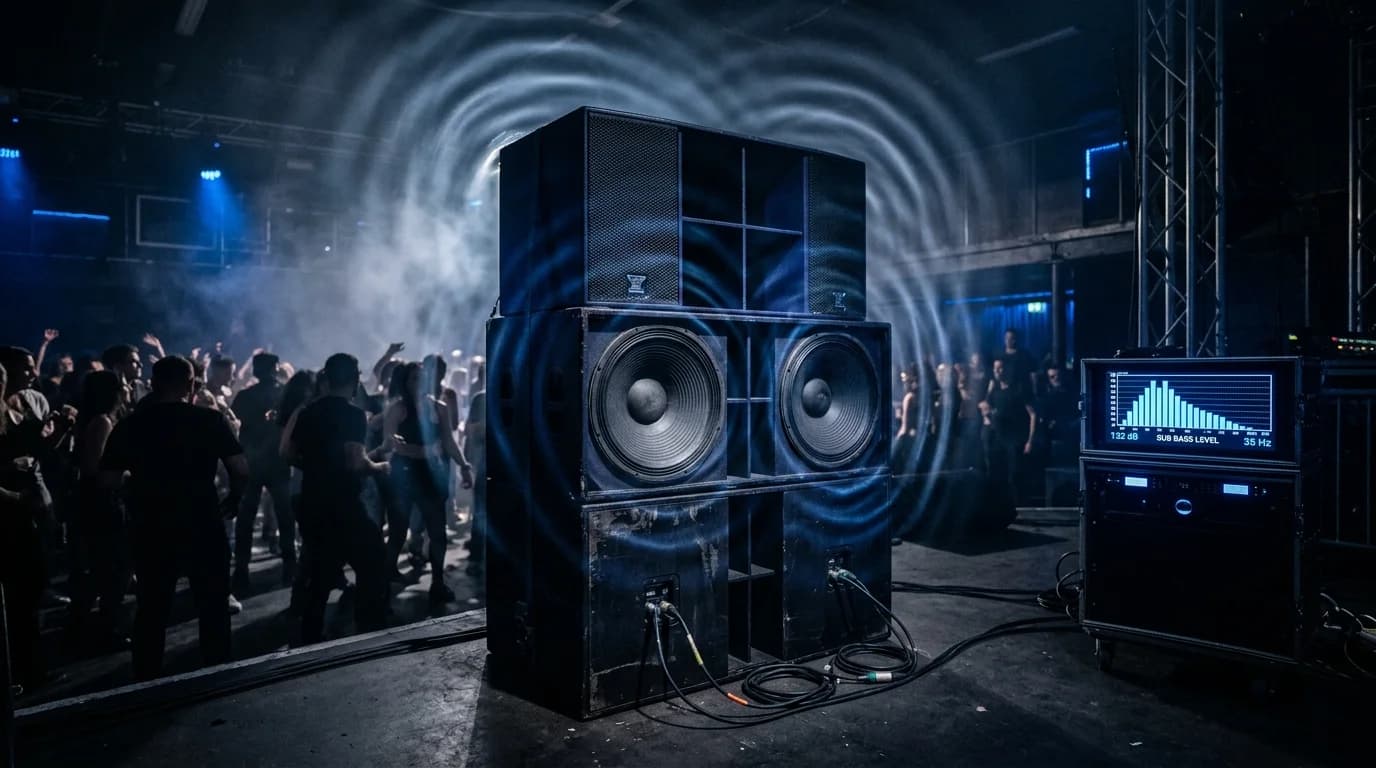
What Is Sub Bass?#
Sub bass refers to the 20Hz-80Hz ultra-low frequency range. Standard speakers cannot reproduce it effectively. You need subwoofers — the kind found in clubs and live venues — to truly experience this range.
These frequencies are not so much "heard" as felt. The chest pressure, the gut-shaking rumble, the vibration through the floor — the physical experience at the core of club music is driven by sub bass.
Sub Bass Frequency Breakdown#
Deep Sub (20Hz-40Hz)#
Near the limits of human hearing. Perceived more as air pressure than sound.
- Sensation: Chest-tightening pressure
- Sources: 808 kick sustain, sub bass synth fundamentals
- Requirements: 18-inch or larger subwoofers. Not reproducible on phones or earbuds
Mid Sub (40Hz-60Hz)#
The core of the sub bass range. This is where kick drum weight and bassline presence are determined.
- Sensation: Deep, gut-level impact
- Sources: Kick drum low end, bassline fundamentals, dubstep wobble bass
- Requirements: 15-inch or larger subwoofers. Most studio monitors are insufficient
Upper Sub (60Hz-80Hz)#
The boundary between sub bass and low end. Proper energy here adds warmth and body to music.
- Sensation: Fullness and thickness
- Sources: Electric bass fundamentals, synth bass harmonics
- Requirements: Standard studio monitors (8-inch or larger) can reproduce this range
Club Sound Systems and Sub Bass#
Subwoofer Systems#
Club subwoofers operate in a different league from home audio:
| System | Subwoofer | Frequency Range | Characteristics |
|---|---|---|---|
| Funktion-One | F124 (24-inch x1) | 25Hz+ | Clean, precise low end |
| d&b audiotechnik | SL-SUB (21-inch x2) | 32Hz+ | Even distribution pattern |
| Pioneer Pro Audio | XY-218S (18-inch x2) | 30Hz+ | High output, large venues |
| Martin Audio | SXH218 (18-inch x2) | 28Hz+ | Hybrid horn design |
On these systems, sub bass physically dominates the space. Whether a track has proper sub bass content makes a dramatic difference in how the floor feels.
Cardioid Subwoofer Arrays#
Modern clubs commonly use cardioid subwoofer placement — a combination of forward-facing and rear-facing subs that reduces low-frequency spill toward the stage. This arrangement makes sub bass phase alignment critically important. Phase-misaligned sub bass can be unintentionally cancelled by the cardioid configuration.
Mobile vs. Club Playback#
Smartphones and Earbuds#
Phone speakers physically cannot reproduce 20-80Hz. Even earbuds struggle below 60Hz. Producers and DJs who check their work only on phones and headphones cannot accurately assess sub bass content. The common complaint of "it sounded great on headphones but was thin in the club" traces directly to this gap.
Car Audio#
Car subwoofers can reproduce club-like low frequencies, but the enclosed cabin creates room modes (standing waves) that exaggerate or cancel specific frequencies. Useful as a reference, but not accurate enough for final decisions.
Club Systems#
Large-venue subwoofers reproduce sub bass faithfully. Any mastering issues are exposed immediately:
- Too much sub bass: Excessive speaker excursion causes the mids and highs to "wobble." Everything sounds muddy
- Too little sub bass: No weight or physical impact. The floor feels empty
- Phase problems: Sub bass disappears when summed to mono (phase cancellation)
Sub Bass Processing Best Practices#
1. Mono Below 80Hz#
Making sub bass mono is industry standard. Here is why:
- Subwoofers typically run in mono
- Stereo content in the low end causes phase interference
- Mono summing concentrates sub bass energy for more punch
2. High-Pass Filtering#
Frequencies below 20Hz have no musical purpose but waste speaker excursion. Apply a high-pass filter at 25-30Hz to remove inaudible ultra-low content.
3. Kick and Bass Separation#
The most critical challenge in the sub bass range is getting kick drums and basslines to coexist cleanly.
- Sidechain compression: Automatically duck the bass when the kick hits
- Frequency separation: If the kick fundamental is at 50Hz, place the bassline at 60Hz or above
- EQ carving: Notch-cut the bass at the kick's fundamental frequency
4. Sub Bass Pitch Management#
Sub bass synth pitch dramatically affects output level:
- E1 (41.2Hz): Standard sub bass pitch. Most speakers handle this well
- C1 (32.7Hz): Deeper sub bass. Requires large subwoofers
- G0 (24.5Hz): Extremely low. Only a few systems can reproduce this
Since the sub bass pitch follows the song's key, different songs produce different amounts of sub bass energy. This variance is important to understand.
DeckReady's Sub Bass Processing#
DeckReady automatically handles sub bass processing with its presets.
Club Ready Preset#
- 25Hz high-pass filter: Removes inaudible ultra-lows to reduce speaker strain
- 40-60Hz reinforcement: Ensures sub bass presence without excess
- Low-end mono summing: Converts stereo content below 80Hz to mono
- Phase correction: Detects and optimizes sub bass phase alignment
Bass Heavy Preset#
- Sub bass boost: +2-3dB at 40-80Hz for impactful low end on large systems
- Low-end tightening: Fast-release compression prevents the boost from sounding boomy
- Mono below 80Hz: Eliminates phase issues at the source
Lounge Preset#
- Sub bass reduction: Gentle rolloff below 40Hz for small-speaker playback
- 60-100Hz warmth: Emphasizes the warm upper-sub to low-end region
- Conversation-friendly: Prevents excessive low-frequency vibration from interfering with speech
Monitoring Sub Bass Accurately#
Recommended Setups#
- Studio monitors + subwoofer: Most accurate. Dedicated subs like KRK S10.4 or Genelec 7360
- Open-back headphones: Sennheiser HD650 or Beyerdynamic DT990. Limited sub bass reproduction but useful for balance checks 3. Spectrum analyzer: Visual confirmation of sub bass levels. SPAN (free plugin) is the standard choice
What to Check#
- Is energy concentrated at 40-60Hz?
- Is there unwanted content below 20Hz?
- Do tracks in different keys show wildly different sub bass levels?
- Does sub bass disappear when switching to mono?
Genre-Specific Sub Bass Tips#
Techno/Tech House#
Kick drum sub bass (40-60Hz) drives the groove. Basslines sit above 80Hz to avoid conflict. DeckReady's Club Ready preset is ideal.
Dubstep#
Sub bass is the star. 30-50Hz is emphasized heavily, and drops are built around sub bass alone. Use the Bass Heavy preset to ensure this range hits hard.
Hip Hop/Trap#
808 kick sustain is the sub bass foundation, concentrated around 40-60Hz. Trap tracks feature extremely long sustain. Bass Heavy preset works well, but verify that long 808 tails are not over-compressed.
Deep House/Ambient#
Sub bass is subtle, with warmth coming from 60-100Hz. Excessive sub bass boost is counterproductive. Use the Warm Analog or Lounge preset.
Conclusion#
Sub bass is the physical backbone of club music. Processing the 20-80Hz range correctly is easy to overlook when monitoring on phones or headphones, but it makes a decisive difference on large sound systems.
DeckReady's presets automatically optimize sub bass: high-pass filtering, mono summing, appropriate boost levels, and phase correction. Instead of performing each step manually, select a preset and get a sub bass balance that translates correctly to club subwoofers.
When preparing tracks for club playback, sub bass should be the first thing you think about, not the last.
Get DJ mastering tips
Weekly tips for music production.
Related Articles
How to A/B Compare Audio Like a Pro — Train Your Ears
Learn the correct way to A/B compare audio before and after processing. Eliminate loudness bias, use blind testing, and focus on the right frequency bands to make better mixing and mastering decisions.
ASMR Recording & Mastering Guide — Capture Whispers Beautifully
Complete guide to recording and mastering ASMR audio. Learn noise floor management, dynamic range optimization, platform-specific LUFS settings, and best practices for whisper-quiet content.
Mastering Tips for Bandcamp Releases — Self-Release Like a Pro
Essential mastering tips for Bandcamp self-releases. Learn optimal upload formats, genre-specific LUFS targets, album consistency techniques, and how DeckReady simplifies Bandcamp mastering.
How to Master Audio for Car Listening — Drive BGM Optimization
Master your music for car audio playback. Learn about in-car acoustics, road noise compensation, subwoofer considerations, and how DeckReady's Club preset optimizes tracks for driving.